If it’s all one, why am I me?
If everything is one awareness, why don’t I hear your thoughts?
Resistance.
The Sovereign Mirror is Nicholas Ferguson’s conversation about the Theory of Sovereign Reflectivity (TSR). It starts from one rule: the main difference between the physical and the nonphysical is resistance.
Keep the relationship.
Flip the condition.
The main difference between the physical and the nonphysical is resistance. Physics already measures one form of it, resistance to a change in motion, and calls it mass.
So take what physics knows and reflect it. Resistant becomes receptive, limited becomes limitless, radiating becomes collecting. Move the mirror and watch the other side come into view. Stop in the middle and you’re in the Present.
Receptivity to a change in motion. Complete in itself and never apart from the whole, like a movement in a symphony.
Resistance to a change in motion.
The relationships carry across the mirror. The quantities don’t.
I don’t think another table holds together like this one. Try to build one that does: different words, the same rule, as many connections and as much sense, or more. Or warm up by reflecting one new piece of physics. Here’s everything an AI needs to play it with you: the rule, the table and what holds each word in place, the three tests, the traps I fell into, and the swaps that failed.
Copy it, paste it into Claude, ChatGPT or Gemini, and choose how to play.
The book asks five questions
In music, a movement is a complete piece that belongs to a larger work. It has its own shape. It was never separate.
- I Why Is There a Particular Me? Your resistance is why you’re a you. Chapters 1–3
- II What Moves Through Me? Energy, flowing four ways at once, all of it running through you. Chapters 4–8
- III Why Does Wanting Hurt? The expansion is never negative. The negative is how the gap feels. Chapters 9–13
- IV Why Can’t We Go Back? You can cover a cut. You can’t uncut it. Chapters 14–17
- V How Far Does This Go? Being sure about the structure isn’t the same as knowing everything it touches. Chapters 18–21
The Present
Everything in this book fits on one picture. I called it The Present.
Four directions, all at once
Choose a symbol, a word, a circle or a moving flow to read what the book says about it and follow what it connects to. On a small screen, enlarge the map or pick a part from the list above.
So what do I do with it now?
Less than you’d think. You don’t have to believe any of it to try it. This is what I actually do, most days, and nothing more.
- Quiet your mind for fifteen minutes a day. Meditation is the simplest way I know to let resistance drop, and when it drops, you rise toward the Current without trying.
- Treat how you feel as evidence. It tells you how far apart what you want and what you’re living have drifted. Read it. Don’t fight it.
- Tune before you Focus. Find the thought that’s a little easier and a little closer to what you want, follow it lightly, and act from there.
- Take the next step you can actually see. When you’re aligned, the distance shrinks to something you can do tonight.
- When you catch yourself straining, let go of the grip, not the want. Remember the five seconds.
- Listen to what comes back In From other people. They’re real. Their no is real. Your ease might be their weight.
- Write it down before, and don’t edit it after.
That’s all of it. The rest of this book is why it works.
A prediction you can check
Chapter 21 makes one prediction you can check in a notebook: when you’re stuck, easing off beats pushing, and it’s the ease that does it, not just the time away. Here’s how to run it so the result means something.
If push and tune come out the same on the page, that part of TSR is wrong.

Where it came from
When I was in fourth grade, in a YMCA league in Denver, I played a basketball game where I couldn’t do anything wrong. My mom and dad and my sister were in the bleachers. By my coach’s stats I had a quintuple double that day: points, rebounds, assists, steals, blocks. Nine years old. I was in the flow, the way athletes talk about it, and somewhere in the middle of it I noticed a voice. It wasn’t quite mine. It was quieter than mine, and simpler. It told me where to go and what to do, and every time I followed it, something good happened. A basket. An assist. A steal.
Afterward I told my mom. I said I could hear another voice in my head, a quieter one, and when I followed it I was always right.
Then she told me I should never tell anybody else about that voice, because they would think I was crazy and lock me up.
So I didn’t. For most of my life I never told anyone.
This book is me telling.
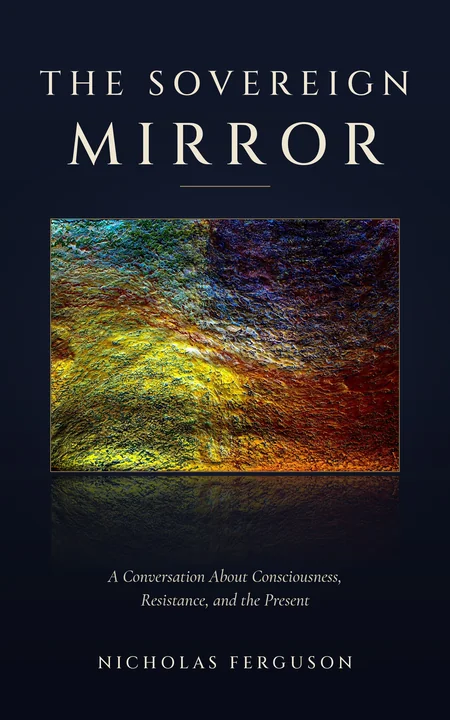
The book
The Sovereign Mirror: A Conversation About Consciousness, Resistance, and the Present
Twenty-one chapters in five movements, a coda, a test you can run, and the Map. Paperback, 176 pages in full color, and Kindle.